

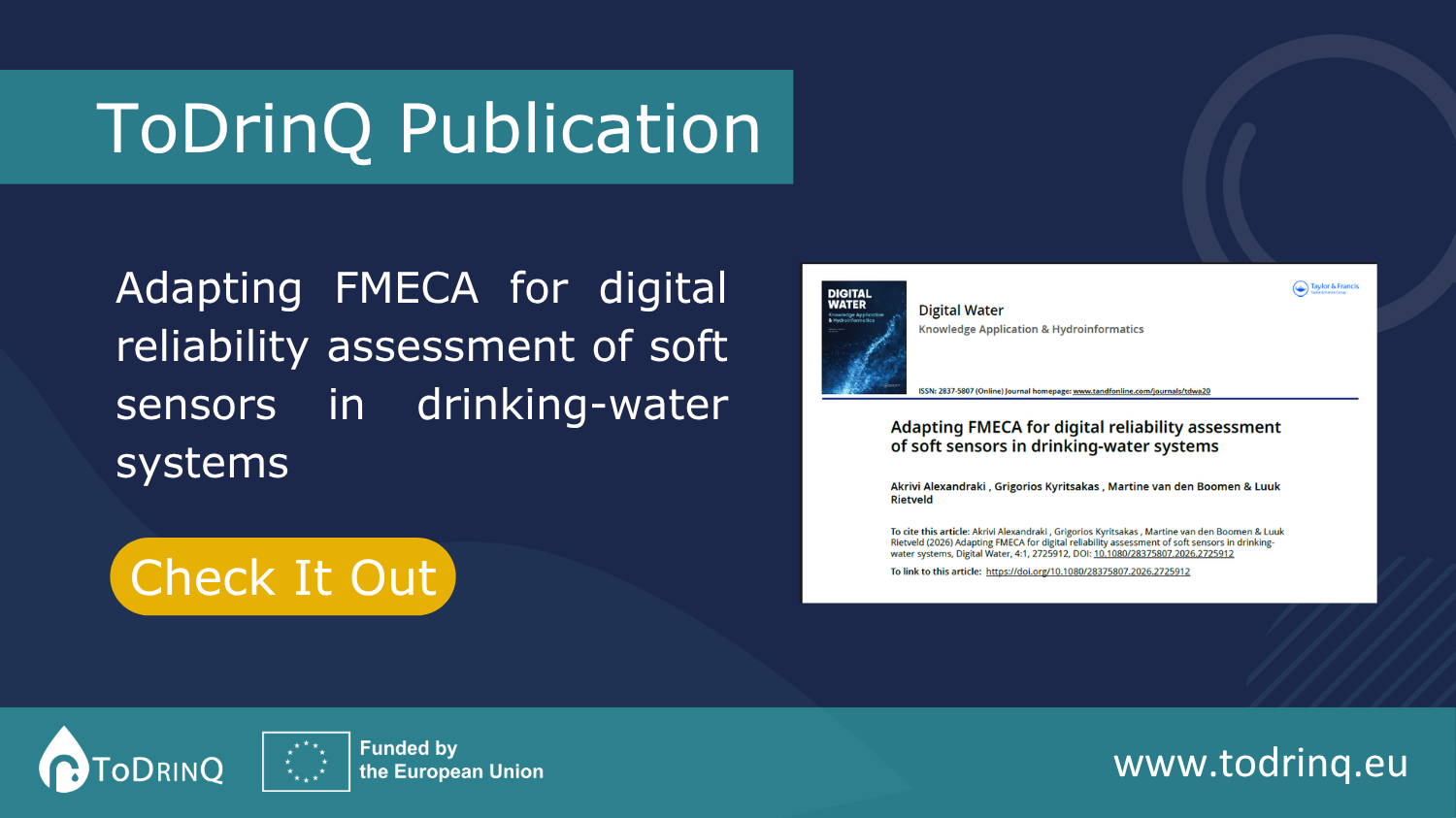
A new open-access research article developed within the ToDrinQ project has been published in Digital Water, a Taylor & Francis journal.
The article, “Adapting FMECA for digital reliability assessment of soft sensors in drinking-water systems,” is authored by Akrivi Alexandraki, Grigorios Kyritsakas, Martine van den Boomen and Luuk Rietveld.
The study addresses an increasingly important challenge for water utilities: how to assess the reliability of digital tools and machine-learning-based soft sensors used to support real-time monitoring and operational decision-making.
Traditional reliability assessments often focus primarily on physical assets or model accuracy. The research adapts Failure Mode, Effects and Criticality Analysis (FMECA) to digital assets, considering failure modes related to data acquisition, preprocessing, model performance and output interpretation. These include issues such as missing SCADA data, model drift and alarm malfunction.
The proposed framework was demonstrated using a CT ozone-exposure soft sensor for disinfection control at Waternet’s Leiduin drinking-water treatment plant. Ten potential failure modes were identified, with the analysis showing that improved detectability and information visibility can substantially reduce operational risks.
The work contributes to ToDrinQ’s broader efforts to support more reliable, data-driven and proactive management of drinking-water quality through digital tools and decision-support systems.
The research was previously presented at the HIC2026 Conference in Zaragoza and forms part of Akrivi Alexandraki’s Engineering Doctorate work at Delft University of Technology.
Read the full open-access article.